Is It Worth Risking Your Life to Save Art
When we think of the heroes in World War II, nosotros commonly remember of individuals who saved others' lives. But what about the heroes who risked their lives to save civilization?
More than than 20% of the art in Europe was looted by the Nazis during World War II, including 600,000 paintings belonging to Jewish owners. At least 100,000 works of art are still missing today. The Nazis' goal was to destroy the history of cultures that they accounted inferior and make certain at that place was no trace left from them. They burned and destroyed many Surrealist, Expressionist, and Cubist pieces (which they categorized as degenerate), sold works such as Impressionist pieces in order to buy other pieces they liked, and kept all the pieces pleasing to Hitler to exist exhibited in his Linz drove.
In June 1943, at the asking of Full general Eisenhower, the Civil Affairs and Military Government Sections of the Allied Armies formed the Monuments, Fine Arts, and Archives (MFAA) department. A group of men and women from thirteen nations, who came to be known as the Monuments Men, volunteered to be part of the MFAA. Many were architects, museum directors, librarians, artists, and educators. "Their job description was simple: to relieve every bit much of the civilisation of Europe as they could during combat," Robert G. Edsel describes in his book "The Monuments Men" (which was the basis of the 2014 movie of the same name). The Monuments Men considered all art to exist equally significant and worth saving for preservation of civilisation. George Stout, an art conservator and 1 of the Monuments Men, stated, "Our job isn't to estimate; our job is to save the art."
On a hot Fri afternoon this summer, I had the laurels to interview both the concluding surviving Monuments Man, Richard M. Barancik, and Ruth Adler Schnee, a Holocaust survivor with a lifelong passion for art. I spent much of my quarantine summer researching the MFAA, so I jumped at the chance to hear the firsthand business relationship of these older figures, and glean the significance of the MFAA department in their eyes.
Richard Barancik
The last surviving fellow member of the Monuments Men, Richard K. Barancik was born in Chicago, Illinois and in December 1942, at the age of 17, enlisted in the Army Enlisted Reserve Corps,, against his begetter'southward will. He joined a special grooming programme and studied bones engineering every bit a cadet in 1943 at the University of Nebraska.
Richard's get-go combat feel was during the Battle of the Bulge. On Christmas Eve, as part of the 66thursday Infantry Sectionalization, he crossed the English Channel to France, and he witnessed part of his unit of measurement torpedoed by enemy submarines. He recalled seeing bodies washing up upon the beach from the S.S. Leopoldville. "It was a terrible tragedy that occurred through a screwup of the British, Belgians and Americans. It was described for many years as the best kept secret of the 2nd World State of war, to avoid embarrassment." Approximately 800 men lost their lives in that tragedy.
After the war ended, Richard was sent to Bagdestein, Austria, where the 66th Division prepared the town'south hotels for the arrival of military camp survivors. While in Badgestein, he noticed on a bulletin board that the Army was looking for men with an art background to join the MFAA. He applied for duty and was selected. For three months, Richard served equally a baby-sit and assisted in moving stolen art to the Wiesbaden Central Collecting Point. "The art was wonderful," Richard said, unlike anything he'd ever seen.
Subsequently the war, Richard studied architecture at Cambridge University in England and the Ecole des Beaux Arts at Fontainebleau in France and became a successful architect with his own firm in Chicago.
Ruth Adler Schnee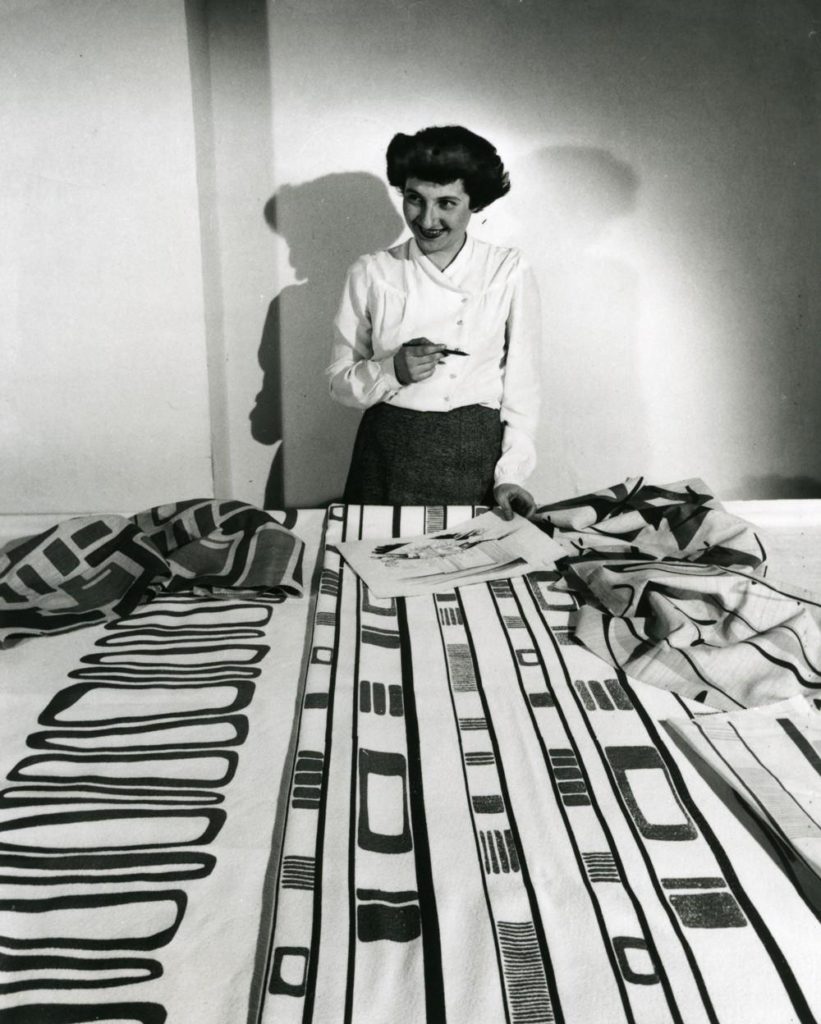
A textile designer and interior designer, Ruth Adler Schnee is familiar with another side of Richard'southward story — those who had art stolen from them. Ruth attended the Degenerate Art Exhibition in Düsseldorf in t 1938. The teenager was in awe of the exhibit, which included examples of Impressionism, Dadaism, Cubism, Surrealism and Expressionism, displayed by the Nazis as examples of fine art that degraded High german culture.
At the time, Ruth was friends with the family of Adele Bloch-Bauer'. Adele was most famously known as the model in the painting "Woman in Gold" by Gustav Klimt, stolen by the Nazis in 1941. Ruth would often go to Adele'southward house to play with her niece and see the painting in their living roomwas. She was also close family friends with the modern artist Paul Klee. Equally a child, Ruth went to Klee's flat, which was correct below hers, and playing with the colorful shapes that he had designed. Ruth's family, who had been in the publishing and rare book business organisation for 500 years, lost everything. Her mother'due south modern art drove was stolen and destroyed by the Nazis. Ruth remembered dreaming with her family about life in a peaceful place.
Ruth and her family endured the insufferable persecution of the Jewish people in Deutschland. Her begetter was imprisoned at Dachau but, miraculously, her mother was able to complimentary him. Though information technology was difficult, her family acquired the necessary papers to leave Germany and emigrate to the United states, where they re-established their lives in Detroit. Ruth connected her studies and was granted a full scholarship to the Rhode Island School of Blueprint for fashion. "Design was my passion," she said. After the war, Ruth became one of the founding figures of textile pattern in the The states.
Her family'southward art and treasures were never retrieved.
The Legacy of the Monuments Men
The Monuments Men rescued five million stolen art pieces and artifacts and restored them to their rightful owners whenever possible. However, tens of thousands of looted pieces are still missing today. In December 1998, forty-iv countries agreed to the Washington Principles on Nazi-Confiscated Art, and gear up a goal to place, locate, and restore all looted artwork. During the terminal 20 years, many museums and fine art galleries accept begun researching paintings that had passed through Europe and had suspicious origins or ownership roots. Almost 30,000 stolen works have been posted and identified on a collaborative portal since then. France, Germany, Austria, the Netherlands, and United kingdom created advisory commissions and accept returned thousands of looted fine art and personal belongings.
In 2009, twoscore-six countries extended the Washington Principles by signing on to the Terezin Declaration. This Declaration included a wider range of institutions beyond museums and art galleries, and extended the definition of confiscated art to include art that was sold by Jewish families who were trying to flee Nazi Germany and needed the money to exercise so. Unfortunately, many other European nations, including Russia, have not cooperated with or supported whatsoever of these declarations, and still have many stolen pieces on display in public and private museums, and traded in markets.
Is Art Worth Lives?
Frequently, people remember fine art is meant to exist displayed in museums and shown to the public only for the sake of its visual appeal. However, Richard Barancik and Ruth Adler Schnee demonstrate that art is a representation of our history, our culture, and our past.
Art never ages and volition never die.
The Nazis understood this ability, and tried to demolish the memory of certain civilizations by taking away their art. It is important that nosotros call up their unjust deportment and never forget those who helped preserve our history.
At the end of the movie "The Monuments Men," the captain of the MFAA section is asked the poignant question: "Is saving fine art worth lives?" I ended both of my interviews with this same question. Ruth enthusiastically said "absolutely!" But Richard gave me an unexpected answer: "If I were [one of] the ones that died, I would say no. The fine art that was saved was wonderful, and the Monuments Men did wonderful things, simply information technology'south non worth someone'due south life." Their contrasting responses likely stem from their very different lives. For Ruth, art and artifacts were a testament of her family's existence and her heritage. Just Richard was a soldier, who witnessed the horrors and damages to human life that the war caused with his ain eyes.
I once would have agreed with Richard if I was asked this question. But after doing each interview, I couldn't help but think of the MFAA soldiers that were killed for the sake of art during the war. Their deaths conveyed a powerful message: Saving fine art is worth a human life because it ways saving our power to certificate our history, maintain our identity, and preserve our culture through time. Art provides a personal and emotional perspective on history that allows us to sympathize others' experiences every bit humans. In an age in which applied science can be manipulative and any version of history spread online, art is like a chief source that serves as proof of the humanity of others across time and cultures. What is more valuable than that?
Amalia Abecassis is a tenth-grade student at Shalhevet High School.
Yous'll love our roundtable.
allshousetherencough.blogspot.com
Source: https://jewishjournal.com/culture/324564/is-saving-art-worth-lives/
0 Response to "Is It Worth Risking Your Life to Save Art"
Post a Comment